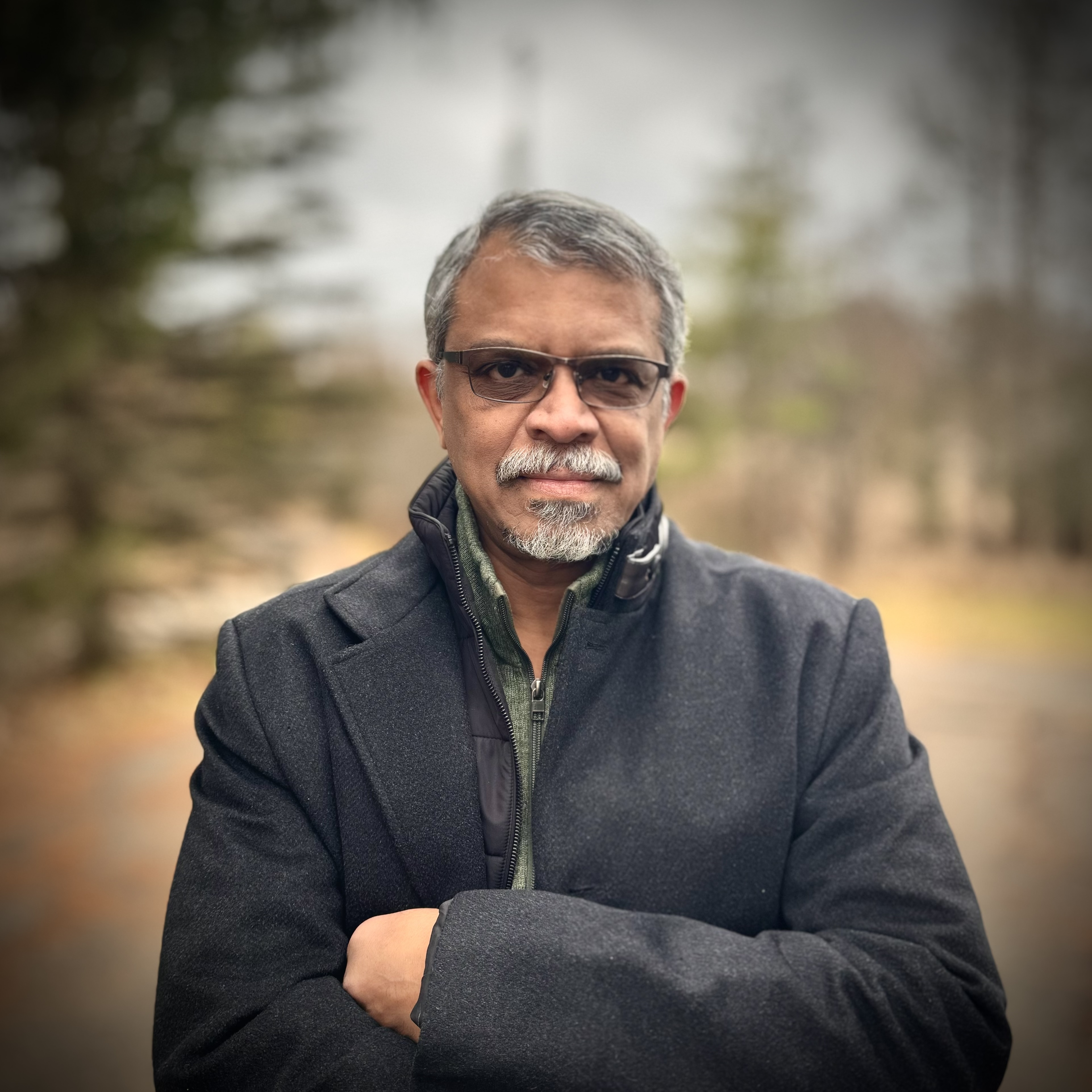
My name is Raaj Shinde. I am an engineer, lifelong student, amateur radio operator, writer, tinkerer, and an incurably curious human being.
Like many people of my generation, my fascination with radio began long before I ever held an amateur license. As a teenager growing up in India, I spent countless late nights listening to shortwave broadcasts drifting in from distant parts of the world. Long before the internet connected humanity digitally, radio hinted at something profound: invisible waves carrying voices, ideas, cultures, music, politics, and human experience across oceans and continents.
Those evenings planted something deep in me.
My first direct encounter with amateur radio itself came at a Boy Scout Jamboree-on-the-Air sometime in the 1970s. Operators were talking across the world using equipment some of them had built themselves. I wanted that immediately.
But getting licensed in India in those days was genuinely difficult, and even if I had navigated the bureaucracy, the equipment itself was simply out of reach. Nothing for amateur radio was manufactured domestically, and importing gear was a luxury well beyond what a middle-class family could consider.
And so amateur radio remained, for a while, an aspiration rather than a practice.
What I could do was listen.
With a National transistor radio and a succession of homebrewed antennas, I became a dedicated shortwave listener — chasing QSL cards, logging stations, and gradually learning how to pull signals out of noise with increasingly better antennas and propagation intuition. In retrospect, I was doing much of what amateur radio operators do, just without a transmitter or a license.
By then, my interests had already begun drifting toward engineering and computation. I earned a Bachelor of Science in Electrical Engineering from the University of Bombay, with an emphasis on microcomputers. For my final-year thesis in 1982, I wrote a software simulator for the Zilog Z-80 microprocessor on a BBC Microcomputer with 32 kilobytes of memory.
Later, I completed a Master of Science in Electrical Engineering at the University of Missouri–Rolla, now Missouri University of Science and Technology, specializing in Optimal Control Theory. My graduate research focused on the multivariable identification and control of a uranium dioxide chemical process — work that deepened a lifelong fascination with systems, signals, models, feedback, and the subtle ways complex behavior emerges from interacting variables.
When I eventually came to the United States, getting licensed was comparatively straightforward. Years of SWL experience and an engineering background meant the examinations held few surprises. I hold an Amateur Extra Class license, callsign KI8JI. My previous callsign was KC8IWP.
Then life intervened - I become an entrepreneur and founded a cloud computing consulting company, and radio went quiet for nearly 25 years.
Over the decades, my professional life carried me through software architecture, technology leadership, systems design, analytics, and consulting. But underneath all those roles, the deeper thread remained remarkably constant: an enduring fascination with how things work — and perhaps even more importantly, how little we truly understand.
Now I find myself returning to amateur radio with very different questions than the ones I had when I was younger. It is no longer just about making contacts or chasing DX, though those things still hold their own magic. Increasingly, I find myself asking deeper questions: What is actually happening when RF leaves an antenna and travels across the world? What do we really mean by fields, waves, resonance, impedance, propagation?
Those questions turn out to be far more interesting than I expected.
This site is where I document the inquiry — and some of the answers that emerge from it.
Engineering teaches humility. Science teaches humility. Radio teaches humility.
Signals fade. Models fail outside their assumptions. Propagation surprises us. Noise masquerades as certainty. Yet now and then, through careful observation, experimentation, mathematics, intuition, and patience, something remarkable happens: a small piece of reality reveals itself a little more clearly.
That process of inquiry has become far more important to me than certainty itself.
Amateur radio, at its best, quietly teaches this lesson over and over again.
A simple wire antenna can sometimes outperform elaborate systems under the right conditions. Tiny changes in the ionosphere can alter global propagation. Two operators using nearly identical equipment may experience entirely different results.
Experience matters. Intuition matters. Patience matters. And certainty is usually dangerous.
That, to me, makes radio more than a technical hobby.
It becomes a living laboratory for curiosity.
In many ways, the real journey began decades ago — with a teenager sitting quietly beside a radio, listening to distant voices emerge mysteriously from noise and static.
I still feel that same sense of wonder today.
And perhaps that is the real point of all this.
Not certainty. But wonder.
Leave a Comment