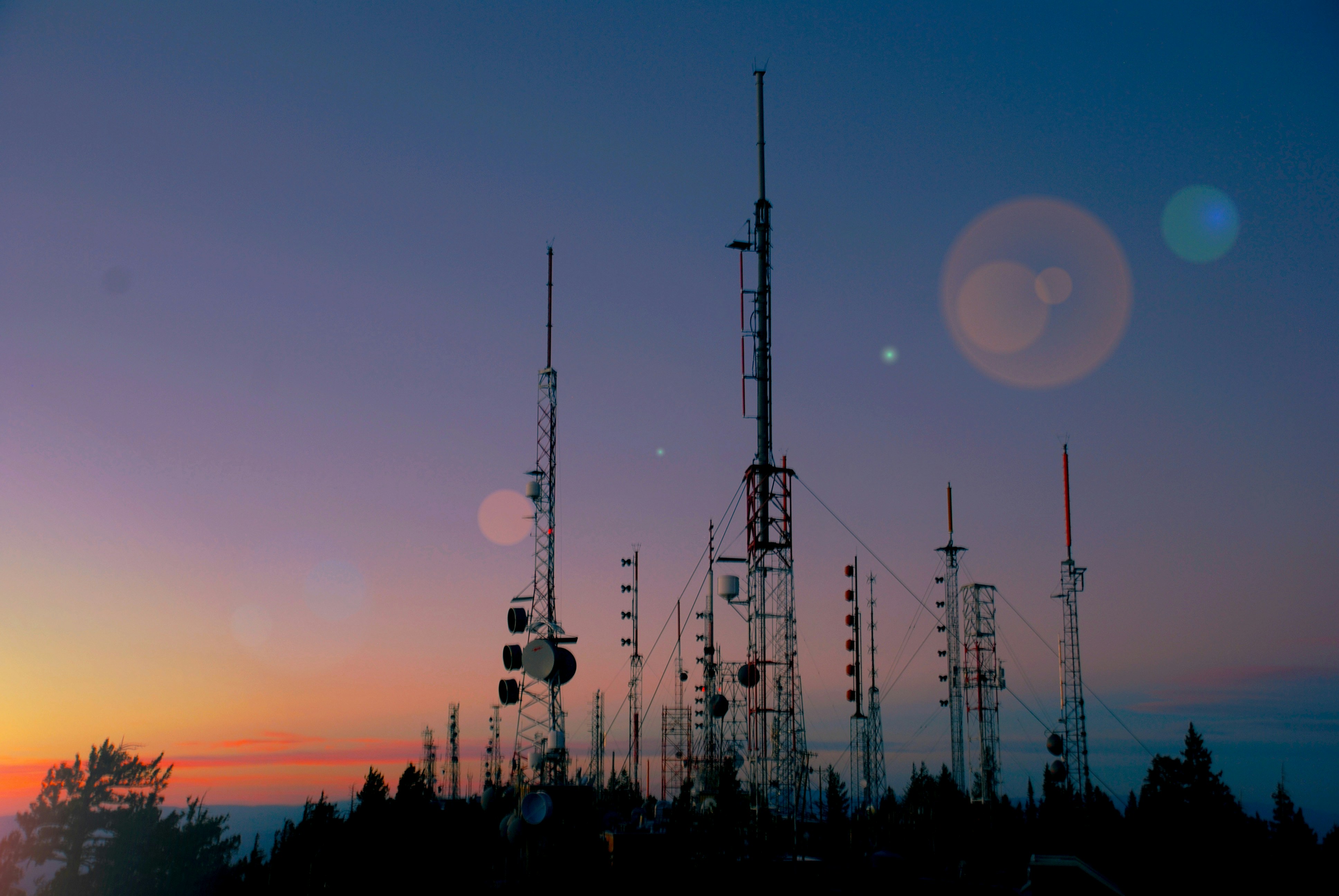
Photo by Scott Elkins on Unsplash
Recently, while searching through the ARRL Handbook for a discussion of fields, I found myself struck by something curious.
I have been a Life Member of the ARRL since the late 1990s, and the Handbook sits within arm’s reach of my operating position. It is one of the finest engineering references ever produced for amateur radio.
And yet, for a concept so foundational to radio itself, the Handbook had remarkably little to say about what a field actually is.
At first, that seemed surprising. Electromagnetic fields sit at the very foundation of radio itself. Antennas create them. Waves emerge from them. Transmission lines guide them. RF propagation depends on them. Surely the concept would occupy center stage.
But the more I thought about it, the more I realized the Handbook was not omitting something important at all.
It was doing exactly what engineering references are supposed to do.
Engineering and science, although deeply connected, are not quite the same enterprise. They ask different questions.
Engineering references primarily answer the question:
How do I make this work?
Scientific inquiry often asks a different question:
What is actually happening?
Both questions are legitimate. Both are valuable.
But they are different questions — and knowing which one you are asking, and what kind of answer you are receiving, matters enormously.
The ARRL Handbook embodies the engineering tradition beautifully. It is practical, empirical, experience-driven, and optimized for action. It contains generations of accumulated experimental wisdom: circuits that work, antenna dimensions that produce results, transmission line formulas that predict behavior accurately enough to build reliable systems in the real world.
That is not a limitation. It is actually a tremendous achievement.
Engineering often succeeds long before complete theoretical understanding exists.
Steam engines worked before thermodynamics was formalized.
Antennas radiated before Maxwell unified electricity and magnetism mathematically.
Engineers routinely build systems that function extraordinarily well using approximations, empirical models, and accumulated experience.
In many ways, this is one of engineering’s greatest strengths. Reality is too complicated to model perfectly, so engineering embraces useful approximation. It accepts abstraction. It optimizes for reliability, predictability, robustness, and practical utility.
And remarkably often, that is enough.
But there is another kind of curiosity that occasionally emerges — particularly among people who spend enough years around radios, antennas, propagation, and measurement equipment.
Eventually, some operators begin asking questions that practical engineering references are not really designed to answer.
What exactly is a field?
What does it mean for energy to “radiate” from an antenna?
At what point does a changing electric field become a propagating electromagnetic wave?
Why do simplified models work as well as they do?
And where do they stop working?
These are not engineering questions in the usual sense. They are closer to scientific or foundational questions. They are questions about understanding rather than implementation.
The distinction reminds me of the old observation that:
The map is not the territory.
Engineering knowledge is a map — often an extraordinarily accurate one. The formulas, approximations, rules of thumb, and design methods used throughout amateur radio are not wrong. Quite the opposite: they are highly refined maps of electromagnetic and radio frequency circuit behavior, validated by decades of experimentation and practical success.
But maps and territories are not the same thing.
A map optimized for navigation does not necessarily explain the geology of the terrain it represents. A subway map may be extraordinarily useful while remaining geometrically distorted. An antenna model may predict feedpoint impedance accurately while still leaving deeper questions unanswered about the underlying physical reality.
Most of the time, this distinction hardly matters. If the antenna loads properly, radiates efficiently, and produces good contacts, the engineering map has done its job.
But occasionally something unexpected happens.
A supposedly inferior antenna outperforms a carefully optimized design. Common-mode currents appear where they “shouldn’t.” A feedline radiates unexpectedly. Propagation predictions fail dramatically. Measurements disagree with simulations. The standard approach stops working in some novel or poorly understood situation.
And suddenly, understanding the territory begins to matter more than simply knowing the map.
One of the remarkable things about amateur radio is that it places ordinary individuals unusually close to the underlying physics itself.
In most technical disciplines, layers of abstraction separate practitioners from fundamental phenomena. A software engineer rarely needs to think about semiconductor band structure. A civil engineer seldom needs to think about crystalline defects in steel. Modern specialization creates distance from first principles.
Amateur radio is different.
A radio amateur with an antenna analyzer, a VNA, modeling software, a spool of wire, and enough curiosity can directly explore real electromagnetic behavior in the physical world. One can build an antenna in the morning, model it in the afternoon, measure it in the evening, and discover by nightfall that reality still contains surprises.
That proximity to the underlying physics is rare.
And valuable.
It creates an unusual opportunity not merely to use technology, but to inquire into the nature of reality itself.
To be clear, none of this diminishes the engineering tradition of amateur radio in the slightest. Quite the opposite. The practical engineering culture of amateur radio is one of the great intellectual traditions of the hobby. The accumulated empirical knowledge contained in ARRL publications, antenna handbooks, design notes, QST articles, and decades of operator experience is extraordinary.
And the scientific spirit has always existed alongside the engineering one.
The ARRL itself has long published deeply investigative technical work — through QST, the Antenna Compendium series, propagation studies, weak-signal experimentation, microwave research, and the contributions of technically curious operators who pushed beyond practical formulas into deeper physical understanding. Amateur radio has always contained both builders and investigators, practitioners and experimenters, engineers and scientists — often embodied in the same person.
The distinction, then, is not between “good” and “bad” approaches.
It is between different modes of engagement with reality.
Engineering asks:
How do I make this work reliably?
Science asks:
What is actually happening here?
Amateur radio, uniquely, allows us to explore both.
And perhaps that is one reason the hobby remains so endlessly fascinating.
Because beneath the contacts, the antennas, the feedlines, the propagation forecasts, and the equipment specifications lies something deeper: an invitation to curiosity itself.
An invitation not merely to operate radios, but to wonder about the invisible world they reveal.
Which brings us naturally to the next question we will explore:
What exactly is a field?
Leave a Comment